

Thematic projects
Global Space Age
In 2019, 95% of space-sector revenue came from space-for-earth activity. The growth is in the other 5%.
This is research, not a product. There is no vehicle, no ISIN and no share class behind it.
- Space-sector revenue earned from space-for-earth activity
- 95%
- As at
Share of an estimated $366bn of global space-sector revenue, on third-party industry estimates. The thematic's argument is that the growth is in the remaining share, not in this one.
- Companies in the space-to-space ecosystem that are listed
- under 15%
- As at
GATE Capital Management's own count of the ecosystem it researches. This is the constraint that keeps the theme a research project rather than a product.
Space-to-space, not space-for-earth
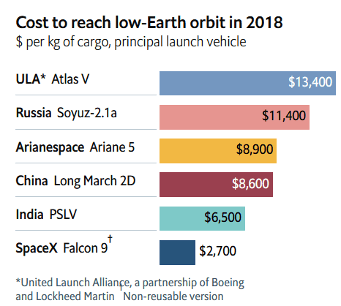
SpaceX commoditised the low-orbit economy and, in doing so, drove the satellite sector. The sub-activities in the low-orbital economy that remain interesting are commercial cargo and crew flights, and satellite manufacturers able to evolve into deep-space technology.
Almost all of the revenue earned in the space sector today comes from the space-for-earth economy. The growth and the innovation will come from the space-to-space economy: goods and services produced in space for use in space — mining the Moon or asteroids for material with which to build habitats or supply refuelling depots.
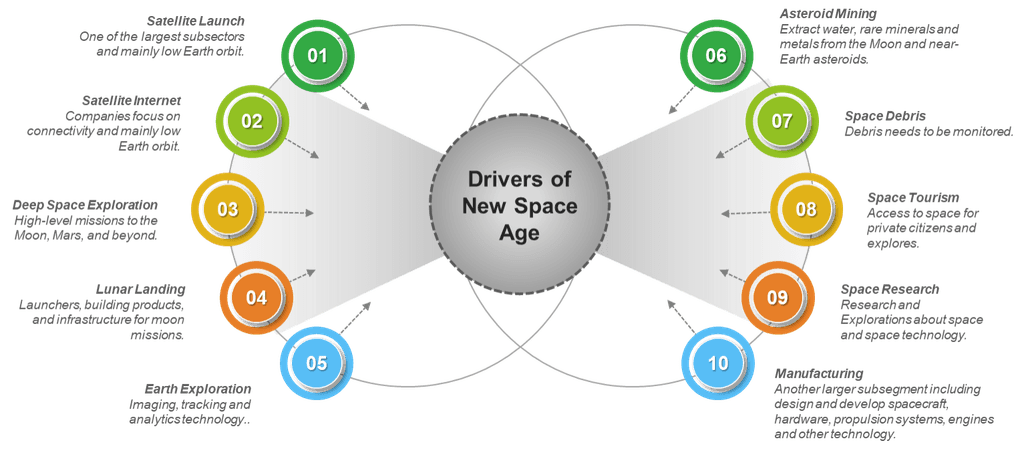
Most thematics sold as space exposure confuse geolocation and the satellite industry with space exploration. Those two sub-themes are a slice of ten drivers, not the whole of it.
The journey to Mars is the driver
The journey to Mars fuels the milestones: more and larger space stations, a permanent base on the Moon, and robots and drones sent to Mars in quantity.
Manufacturing, infrastructure, mining
Made In Space has been manufacturing in space, for space, since 3D-printing a wrench aboard the ISS in 2014, and has since been contracted to print large metal beams in orbit for NASA spacecraft.
Building and operating habitats, laboratories and factories is the second area: Maxar Technologies was awarded a NASA contract to develop a robotic construction tool to be assembled in orbit.
Space mining is the third. The known asteroid count is approaching one million, of which roughly ten thousand are near Earth. Estimates of their mineral content run to figures large enough to be meaningless; the useful question is cost-effectiveness to reach and process, and on that measure Ryugu ranks among the most favourable.
The constraint, stated plainly
Only a small minority of the companies in this ecosystem are listed. That is the honest difficulty of the theme, and the reason it is presented as research rather than as a product.
China is becoming a major player
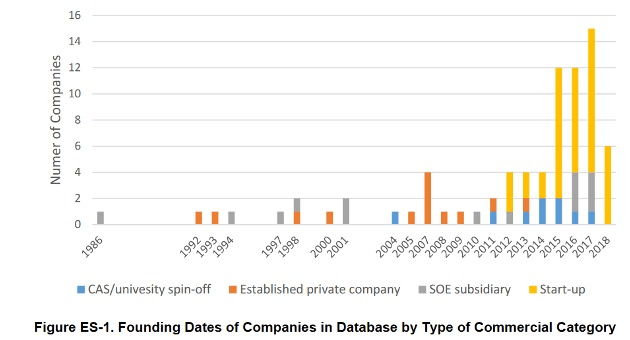
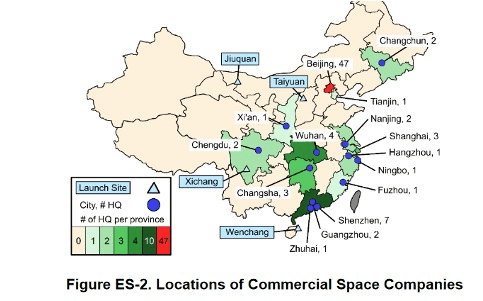
China is the third nation to launch humans into space independently. The 2015-2025 Medium- and Long-Term Plan for National Civil Space Infrastructure places a premium on indigenous innovation in high-technology industries.
The programme was slowed by the pandemic in 2020 and not stopped: a rover to Mars, moon rocks returned to Earth, and a test of the next-generation crewed vehicle. Less noticed was the November 2020 launch of Ceres-1, a new rocket just 62 feet tall.
| Year | Focus |
|---|---|
| 2022 | Globalisation and Mars |
| 2023 | Asteroids, the Moon and Mars |
| 2024 | The Moon and Phobos |
| 2025 | Phobos and the Moon |
| 2026 | Asteroid and Titan |
| 2029 onward | Mars, Mars and Mars |
Related
-
Thematic projects
The other themes the firm researches without a vehicle behind them.
-
Our macro publications
The whitepapers this research feeds into.