You are reading this page as a What this means The audience selection needs JavaScript. This page shows all of its material, for every reader.

Invested thematics
China Robotics
Automation is industrial policy here, and policy publishes its schedule.
Key takeaways
- The Chinese robotics sector files 44% of total global patents.
- China, Japan and the United States together control about 58.7% of global filings.
- China accounts for roughly 140,500 industrial robot installations.
- The special-service segment, covering drones and hazard-rescue robots, is expected to grow faster than the industrial segment.
- Of the nearly 100 medical robot companies in China, most are still in infancy.
Strategy facts
- Vehicle
- Actively managed certificate
- Class
- Invested thematic
- Currency
- USD
- Inception
- Product code
- CE0032ALU
- ISIN
- XS2396293933
- Status
- Open
Documents
Monthly report
Term sheet
Two-pager
Automation as industrial policy
Before the place of robots in China can be judged, the segmentation of the supply chain has to be understood: upstream components, midstream assembly, and downstream system integration behave as three different industries with three different margins.
Beijing's Made in China 2025 plan is a strategy to upgrade the industrial base and cut reliance on foreign technology. Robotics is named in it, which makes the demand schedule a matter of published policy rather than of forecast.
What the pandemic changed, and what it did not
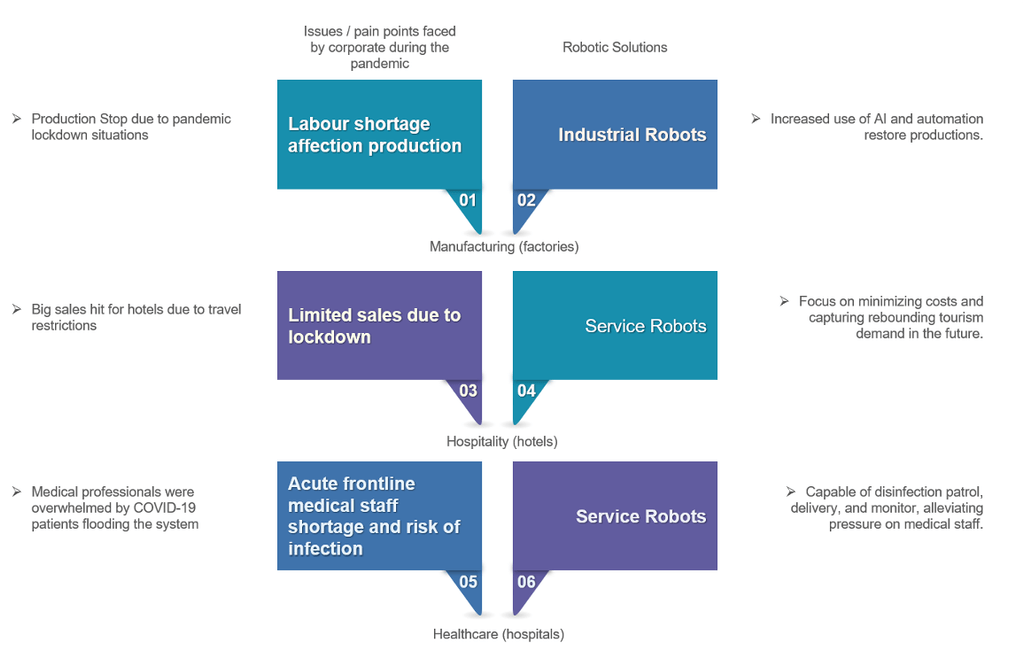
Online collaboration tools, and tracking and detection systems, persist because awareness of hygiene persists. Service robots and drones in public areas — crowd monitoring, temperature taking, delivery — moved from demonstration to deployment in the same period.
Medical robotics is the exception: of the nearly one hundred medical robot companies in China, most remain in infancy. The theme is real and the listed exposure is not yet there, which is a reason to size it as a position rather than as a conviction.